High school athletes can cash in as MHSAA approves NIL
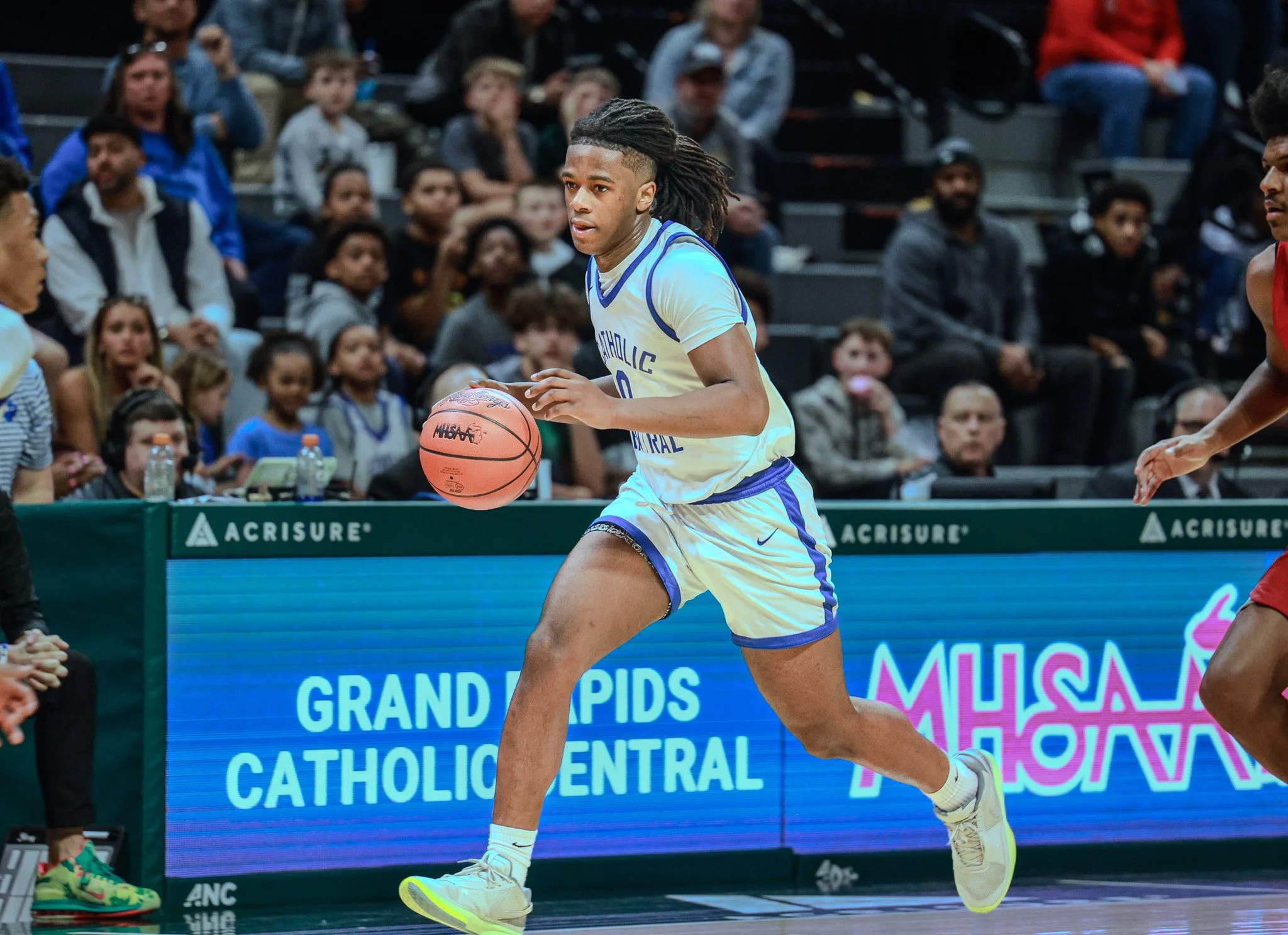
Brieland Watkins of Grand Rapids Catholic Central basketball at the Division 2 state semifinals at The Breslin Center on Friday, March 14, 2025. (Photo | Lenny Padilla).
GRAND RAPIDS, Mich. - The Michigan High School Athletic Association approved a measure that will allow athletes to cash in on their likenesses.
The MHSAA said on Tuesday its Representative Council approved personal branding activities (PBA) effective immediately.
“We have said from the start of this conversation that the MHSAA could be comfortable with a policy that provides individual branding opportunities for individual student-athletes, and this rule change provides those while excluding the possibility of collectives, and boosters and school people getting involved in those activities,” MHSAA Executive Director Mark Uyl said in the news release. “This is the essence of what NIL was supposed to allow in the first place, and we’re confident we’ve crafted language that allows true NIL opportunities without affecting competitive equity among our member schools.”
According to the news release, “Additional activities allowed by the new PBA policy include social media endorsements and promotions, personal appearances, photo sessions or autograph signings; modeling, advertising, merchandise, sports cards or apparel sales; and the use of a student’s name, image or likeness in marketing materials.”
But athletes cannot use anything with a school’s logos or record commercials etc. at an MHSAA school. They also cannot solicit help from a coach or other school employee to set up NIL opportunities or to promote anything they make money off of.
Grand Rapids Northview basketball player Cam Ryans, who has committed to play at Western Michigan University next year, was surprised.
“I was shocked,” Ryans said. “I thought that would take a few more years. With how crazy it is in college, I didn’t think they’d pass it yet.”
Ryans said high school athletes have a hard time making money since they are so busy with playing and working out.
“There’s going to be guys who will try to find loop holes,” he said. “But high school kids can barely work and we have to ask our parents for money. We are putting in work with our sport. So I think it’s good for kids to take advantage of their name, image and likeness.”
Chris Pearl, the boys basketball coach at Grand Rapids Catholic Central, the NIL can be tricky.
“It’s crazy because we’ve seen how NIL in college has taken off,” he said. “Paying college players is a good thing. But for high school, it puts people in a pickle. They’re still kids. I’m dealing with kids who are as young as 14 and as old as 18.”
Pearl said NIL doesn’t equate to success.
“Getting just a few dollars from a local business doesn’t mean you’ve made it,” he said.
Pearl said he’s worried NIL dollars could change an athletes motivation.
“I saw it with guys in college, like where they don’t work hard anymore,” he said. "They got that dollar figure and they aren’t in the gym early the morning. I don’t think we’ll see that in high school. That doesn’t mean you’ll get college offers. Hopefully they’ll still have that hunger.”
NIL cannot be performance based. So someone cannot pay an athlete to score a certain amount of points or for winning an award. The NIL must be reported to the school and cannot contain elicit material, be related to tobacco, alcohol, drugs, firearms or gambling.
According to the MHSAA website, PBA agreements may not:
Be contingent on athletic performance, awards/recognition, team participation/membership or competition outcomes.
Involve school, conference, or MHSAA names, logos, mascots, trademarks, or other obvious identifiers of schools, conferences, or the MHSAA, including uniforms, facilities, nicknames, property, websites, and social media accounts of each.
Occur during school attendance, or while participating in any MHSAA event, including any practice, meeting, game, or tournament.
Be connected directly or indirectly to any associated entity (e.g. collective or school-connected booster, foundation, or support) or associated individual with a school (e.g. employee, board member, booster, donor, coach, alumni, owner or representative. A licensed sports agent, financial advisor, or attorney who does not fall within the definition of “Associated Entity or Individual” above may serve as a student-athlete’s agent or representative in connection with PBA opportunities, subject to applicable laws. The full definition of Associated Entity of Individual can be found here.
PBA associated with products, services, individuals, companies, or industries deemed inappropriate, unsafe, or inconsistent with the values and goals of interscholastic athletics as determined by the MHSAA, within its sole discretion. This includes, but is not limited to, gaming or gambling, alcoholic beverages, tobacco, cannabis, banned or illegal substances (including performance-enhancing substances), sexually explicit content, firearms or weapons, or any other category the MHSAA determines to be unsuitable or inappropriate.
For a list of the new MHSAA NIL rules, click here.